The Missing Link in Climate Strategy: Soil Health
Most climate strategies focus on emissions, energy, technology and reporting. Companies measure their carbon footprint, set reduction targets, invest in renewable energy and look for ways to make their operations more efficient. Yet one of the systems that underpins climate resilience, biodiversity, water management and carbon storage rarely takes center stage: soil.
Soil is where climate, biodiversity, water and land use meet, but it is does not get the attention it deserves from the current strategies meant to address them.
Soil health is about more than carbon
Soil is one of the world’s largest carbon reservoirs. Healthy soils can store significant amounts of organic carbon. Degraded soils, on the other hand, can lose carbon and become less productive, less resilient and more vulnerable to erosion.
Soil carbon deserves that attention. Increasing soil organic carbon can contribute to climate mitigation, improve soil structure and support more productive ecosystems.
Yet soil health cannot be reduced to carbon alone.
A soil can contain carbon and still struggle with compaction, erosion, pollution, nutrient imbalance, saturation and less aeration... A narrow focus on caron risks missing the wider system management but determines whether soil is truly healthy and functional.
If we want to restore soils in a meaningful way, we need to look at the full picture.
Why soil health connects climate, water and biodiversity
Soil sits at the intersection of many environmental challenges that are often discussed separately.
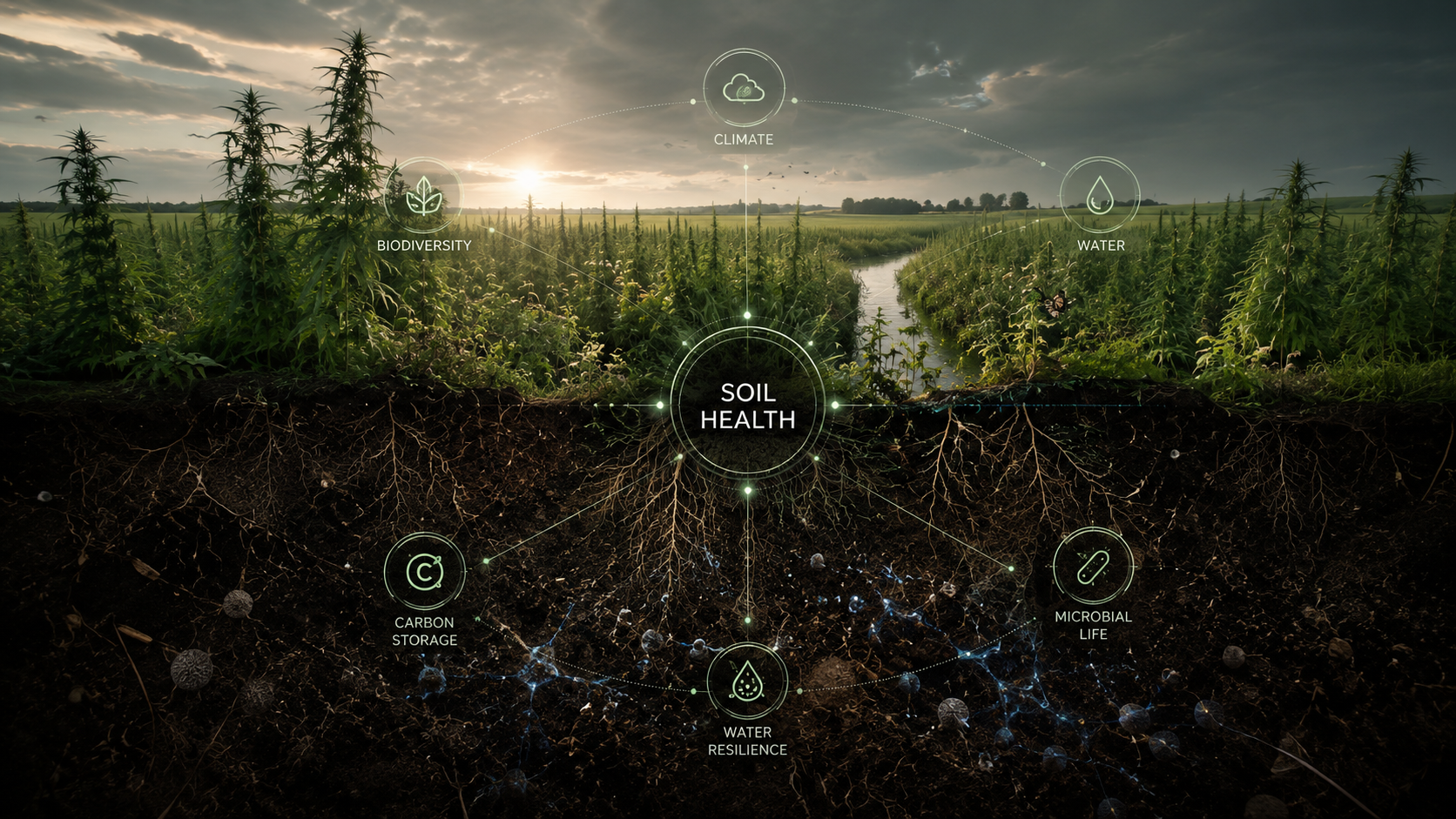
Soil influences many environmental systems simultaneously. Healthy soils retain water more effectively, reduce erosion and help landscapes cope with drought and heavy rainfall. They also support complex biological communities that contribute to ecosystem resilience above and below ground.
Nutrient balance matters too: too little limits plant growth, too much creates leaching to groundwater and pollution. Soil texture, CEC, pH, microbial activity, bulk density and erosion risk all shape whether a soil can actually do its job. These are not separate concerns. They are the same system, measured from different angles.
Treat soil as a single-issue topic and you lose the system. Climate mitigation, adaptation, biodiversity, food security and water resilience all run through it.
From Planetary Boundaries to Soil Health Boundaries
The concept of Planetary Boundaries has helped the world understand that environmental systems have limits. Climate change, biodiversity loss, freshwater use and land-system change are not isolated issues. They are connected pressures on the same planet. A similar way of thinking could help us understand soil.
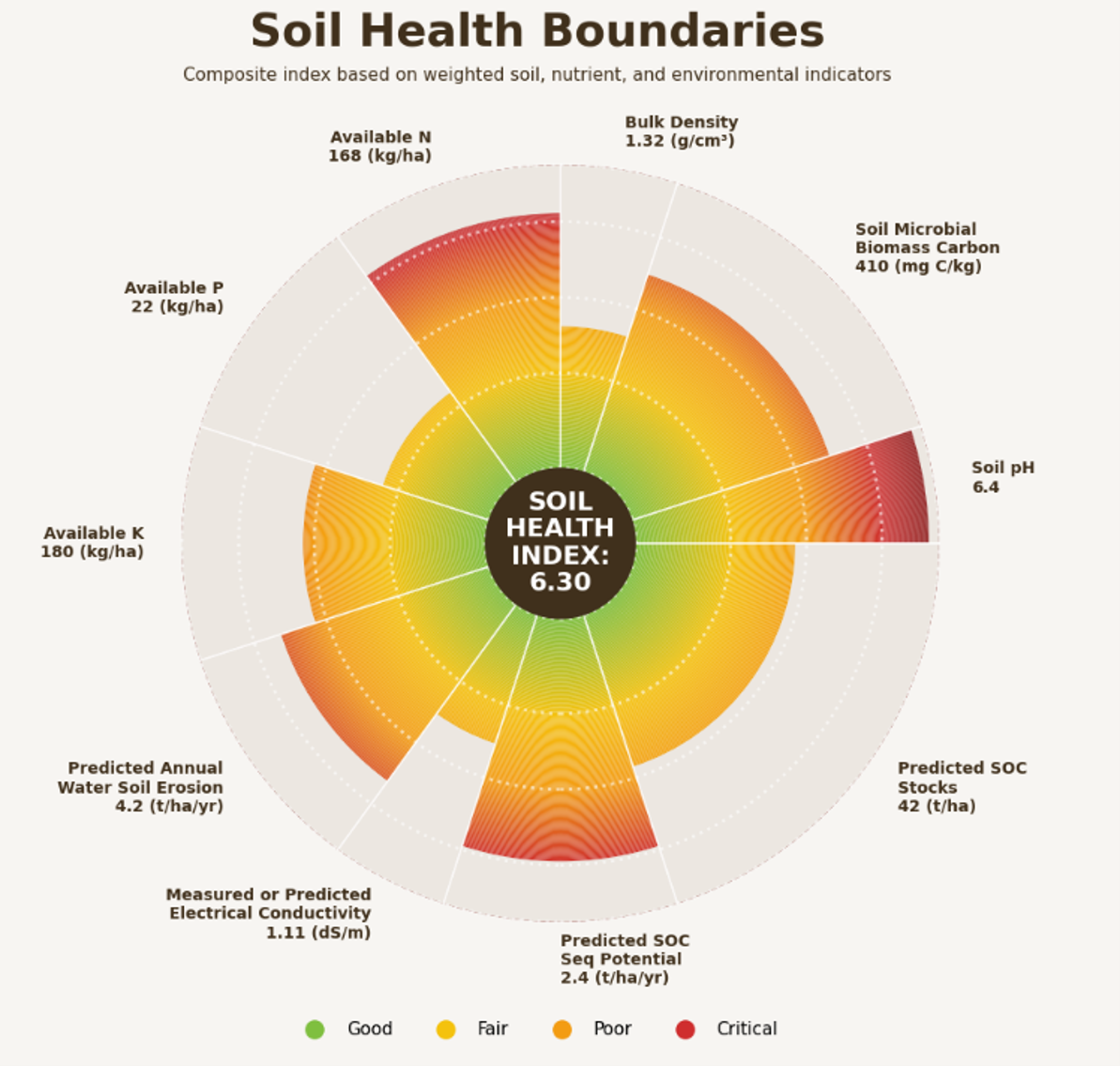
At Earth+, we introduce the concept of Soil Health Boundaries as a practical framework for assessing whether a soil remains within a healthy operating space across multiple indicators.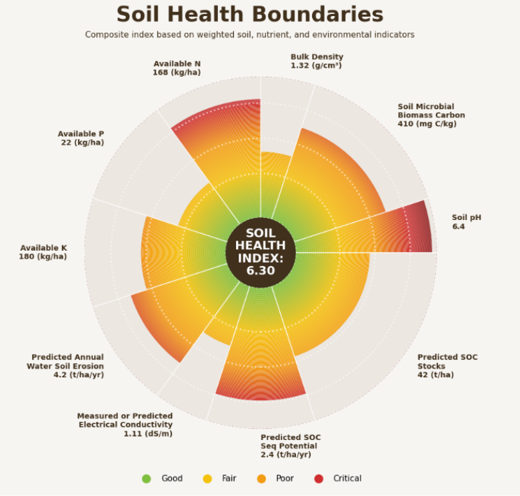
Such a framework would not look only at soil organic carbon. It would also consider indicators such as nutrient availability, pH, microbial biomass, water erosion risk, bulk density, electrical conductivity and the potential for future carbon storage.
Soil health reflects the combined condition of multiple physical, chemical and biological factors. Because these factors are interconnected, changes in one part of the system can affect its overall functioning.
That is where the idea of Soil Health Boundaries becomes useful. It helps shift the conversation from isolated metrics to system health.
Why measuring soil health matters
Soil health can only be improved if it is properly understood. Traditional soil sampling remains important, but it is difficult to scale. Measuring large areas manually is slow, expensive and limited in resolution. It can tell us what is happening at specific points, but not always how a full landscape is evolving.
New technologies can change that. Remote sensing, satellite data, artificial intelligence and smarter sampling strategies can help create a more detailed and dynamic understanding of soil conditions.
Better models can also help turn raw data into knowledge. Instead of measuring only to report, data can be used to learn, predict and improve decision-making. Over time, this makes it possible to monitor soil health more accurately, identify risks earlier and evaluate whether regenerative practices are delivering the expected outcomes.
The European Soil Monitoring Law is a sign that soil is moving higher on the policy agenda. That is encouraging. But if soil monitoring is to become truly useful for climate and land-use strategies, it will need to become more scalable, more integrated and more actionable.
Soil regeneration needs evidence
Regeneration is increasingly used in agriculture, construction, land management and corporate sustainability strategies. As the concept gains traction, the need for evidence becomes more important.
Regenerative claims need evidence. If a project claims to restore soil, improve water resilience, store carbon or support biodiversity, those outcomes should be monitored and verified. This is especially important as companies look for credible climate solutions beyond their own operations. They need projects that can show what is actually changing on the ground. If we want to achieve that at scale, we need models with high predictive power. To build those, we need highly informative data, collected through smart sampling – smart for model building, not merely for reporting. That would be a missed opportunity.
Soil Health Boundaries could help provide that structure. They could make soil regeneration more transparent by showing whether a project improves the wider health of the soil, rather than only increasing one isolated indicator.
Why soil health belongs at the center of climate strategy
Climate strategies have become increasingly sophisticated when it comes to measuring emissions. That same rigor should now be applied to soil. Healthy soils store carbon, support biodiversity, regulate water, improve resilience and sustain productive landscapes. They also create the foundation for regenerative systems that can connect land restoration, biomass production, biobased materials and long-term carbon storage.
In the projects we work on, we see this gap repeatedly: organizations willing to invest in restoration, but without the measurement or prediction infrastructure to understand whether their efforts are delivering the intended outcomes.
Collecting data is part of the solution, but data alone is not enough. When measurement becomes an end in itself, resources are spent on reporting rather than on restoration. The real opportunity lies in developing robust models that turn data into insight, prediction and better decision-making.
That requires high-quality, informative data collected through smart sampling strategies designed for learning and model development, not simply for compliance or reporting.
Healthy soils store carbon, support biodiversity, regulate water and strengthen resilience. Understanding how these systems evolve over time will require more than measurement alone. It will require the ability to predict, prioritise and act.
Ultimately, the goal is not to collect more data. It is to use data intelligently so that more resources can be directed toward restoring the landscapes we depend on.
Frequently Asked Questions
What is soil health, and why does it matter for climate strategy?
Soil health refers to the combined physical, chemical and biological condition of soil, including carbon storage, nutrient balance, microbial activity and water infiltration. It underpins climate resilience, biodiversity and water management, yet most corporate climate strategies overlook it in favour of emissions and energy metrics.
Is soil carbon the same thing as soil health?
No. Soil carbon is one important indicator of soil health, but a soil can hold carbon and still suffer from compaction, erosion, nutrient imbalance or poor water infiltration. Soil health depends on the combined condition of multiple indicators, not carbon alone.
What are Soil Health Boundaries?
Soil Health Boundaries is a framework adopted by Earth+ that assesses whether soil stays within a healthy operating range across several indicators at once, including organic carbon, nutrient availability, pH, microbial biomass, water erosion risk, bulk density and electrical conductivity. The concept adapts the logic of Planetary Boundaries to soil systems.
How can soil health be measured at scale?
Traditional soil sampling is accurate but slow, costly and hard to scale across large areas. Remote sensing, satellite data and artificial intelligence allow soil conditions to be monitored more dynamically, turning raw measurements into predictive models that support earlier risk detection and better decision-making.
Why does soil regeneration need verified evidence?
Claims about restoring soil, storing carbon or improving biodiversity need monitoring and verification to be credible. Companies looking for climate solutions beyond their own operations need proof that regeneration projects are delivering real, measurable outcomes on the ground, not just reported ones.