The Climate Cost of Waiting: Understanding Carbon Debt
Carbon Debt
The Climate Cost of Waiting: Understanding Carbon Debt
A company that reaches net zero in 2040 or 2050 will still have emitted a considerable amount of carbon between now and then, depending on the reduction trajectory. Those cumulative emissions are easily overlooked when companies only focus on their eventual destination. Thinking of them as carbon debt makes their impact visible and raises two important questions for every organisation with a long-term reduction plan. What responsibility do you take for the emissions you continue to produce while working towards net zero? And what do you do about the recurring emissions your own transition plan already tells you will be difficult, or even impossible, to eliminate by the time you reach net-zero?
Carbon debt is not a formal corporate accounting category, and the term has different meanings in climate literature. In the context of a corporate transition, it provides a useful way to think about the emissions that accumulate along a company's reduction pathway.
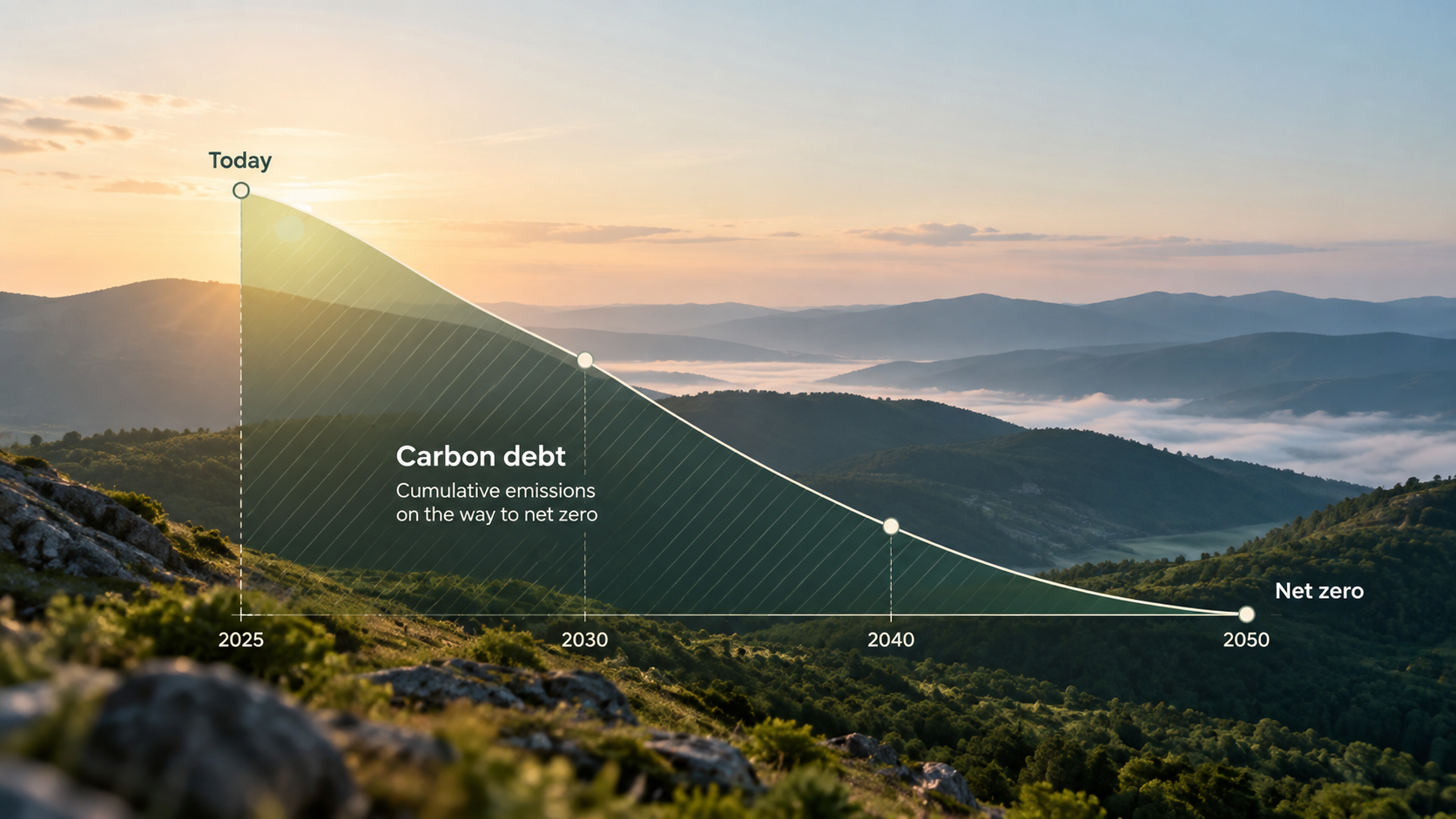
Imagine plotting an organisation's annual emissions on a graph. The curve gradually falls as the company decarbonises, eventually reaching net zero. The emissions represented by the area underneath that declining curve do not disappear. They have entered the atmosphere during the transition and contributed to the cumulative mass of greenhouse gases.
The faster a company brings its emissions down, the smaller that area becomes. Every delay makes it larger.
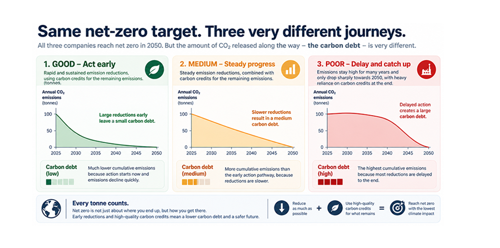
Reaching net zero stops the accumulation, but it does not undo the cumulative emissions produced on the way there. CO₂-driven warming is closely linked to cumulative emissions, which is why the speed and pathway of reduction matter alongside the eventual target.
Reduction takes time, especially beyond your own operations
Every credible climate strategy should prioritise rapid emissions reduction. The challenge is that companies do not have equal control over every part of their footprint and certain required investments don’t happen overnight.
Scope 1 and 2 emissions often offer relatively clear reduction pathways through changes to operations and energy use. Scope 3 is a lot harder. Much of the necessary change depends on suppliers and other companies across the value chain. Businesses need to understand those emissions and work with partners to bring them down, often over many years.
Reduction pathways are also projections rather than guarantees. Some depend on new technologies that still need time to mature and become economically viable at scale. Carbon capture and direct air capture, for example, may have an important role to play. Their future contribution should not become a reason to delay solutions that can already be deployed today. Alongside developing new technologies, we need to transform existing industries and value chains away from fossil resources.
Solutions that are already contributing to industrial transformation often struggle to scale. Biobased materials are one example: they can replace fossil-intensive inputs in sectors such as construction, but producers need demand, investment and production capacity to scale.
The need to finance transition while emissions are still being reduced exposes a problem with a common interpretation of the principle ‘reduce first’. Reduction should unquestionably remain the priority. Treating it as a chronological sequence, however, encourages companies to postpone action on emissions they already know will remain difficult to eliminate for years. It also holds back solutions that need additional finance today to reach the scale required for industrial transformation.
A credible transition plan already gives companies a reasonable view of where many hard-to-abate emissions sit and how much is likely to remain. Rather than waiting until the end of the reduction pathway, companies should reduce their own emissions as quickly as possible while taking responsibility for those they cannot yet eliminate.
Reduce and take responsibility at the same time
Beyond Value Chain Mitigation, or BVCM, provides a framework for doing this. BVCM refers to mitigation action or investment outside a company's own value chain. It takes place alongside the reduction of Scope 1, 2 and 3 emissions and does not reduce the company's reported footprint.
That distinction matters. Financing a climate project elsewhere does not reduce a company's reported footprint. It represents an additional climate contribution while the company continues working on its own transition. High-quality carbon credits are one way to direct that finance towards verified projects, including technologies and transition solutions that need support to scale.
Using carbon finance to accelerate the transition
For Earth+, the greatest value comes when climate finance helps accelerate the transition towards a regenerative economy.
Biobased construction materials show what this can look like in practice. Replacing fossil-intensive materials requires existing industries and value chains to change the resources they use. The alternatives already exist, but they need sufficient demand and production capacity to compete at scale. Carbon finance provides an additional revenue stream that helps make these alternatives commercially viable.
This is exactly the thinking behind initiatives such as Greentripper+, which connects contributions for remaining travel and mobility emissions with local biobased projects. The proximity of those projects gives organisations greater visibility into where their contribution goes and how it supports the wider adoption of renewable materials and regenerative value chains.
Making the area under the curve smaller
A net-zero target tells us when an organisation expects to reach its destination. Carbon debt also asks what it will emit on the way there. Rapid reduction makes that debt smaller, while taking responsibility for remaining emissions also directs finance towards the technologies and industrial transitions needed to bring future emissions down faster. If those emissions are already visible in today's transition plans, there is little reason to wait until the target year before acting on them.
Turn carbon responsibility into transition finance
Earth+ connects companies with high-quality, local projects that use carbon finance to accelerate the transition towards regenerative business models and healthier ecosystems. If your organisation already knows which emissions will remain difficult to eliminate, you can start putting that knowledge to work today.
Talk to Earth+ about how your carbon finance helps scale the transition.
Get in touch